The ToggleLogic Origin Story
We Didn't Build This in a Lab.
We Built It Because We Had To.
How a $100/day AI bill, an AI that forgot everything overnight, and a real-world security breach led to patent-pending technology that makes AI orchestration affordable, intelligent, and secure for every business.
Chapter 01 — The Cost Crisis
The Day We Realized AI Was Too Expensive to Use
In early 2026, Motherboard, Inc. deployed SAM — our Smart AI Manager — to run daily operations for Click IT, our IT services franchise network. SAM handled everything: drafting emails, managing CRM contacts across six sub-accounts, preparing investor materials, coordinating franchise candidates, and interfacing with QuickBooks, Microsoft 365, and a half-dozen other business systems.
SAM was brilliant. SAM was also ruinously expensive.
$100
Peak daily API spend
$3,000
Projected monthly cost
84%
Context window wasted on overhead
The problem was simple: SAM was using the most powerful (and most expensive) AI model for everything — including tasks that didn't need it. A routine CRM lookup burning the same tokens as a complex investor pitch analysis. A daily summary consuming the same model as a full code rewrite.
At those rates, the franchise price points we'd planned — $675 to $9,450 per month — were underwater before a single customer touched the system. The technology worked. The economics didn't.
"If we can't afford to run this ourselves, no small business on earth can afford it. And if they can't afford it, this technology stays locked in enterprise data centers forever."
That realization — that the cost structure of AI model usage was the single biggest barrier between small businesses and transformative technology — is what gave birth to ToggleLogic.
Chapter 02 — The Breakthrough
What If the AI Knew Which Brain to Use?
The insight was deceptively simple: not every task needs the most expensive model. In fact, roughly 80% of what a business AI assistant does — reading emails, looking up contacts, scheduling tasks, generating routine summaries — can be handled by models that cost a fraction of a penny per request.
The remaining 20% — complex reasoning, multi-step analysis, nuanced writing — genuinely benefits from premium models. The key is knowing which is which, in real time, automatically, before the tokens start burning.
We built what we now call the ToggleLogic Engine: a dynamic model evaluator that scores every incoming task across four dimensions — capability required, cost, speed, and context fit — and routes it to the optimal model before a single token is spent.
93%
Cost reduction achieved
6
AI providers orchestrated
<$10
Daily operating cost target
Daily API costs dropped from $100 to under $10. The same SAM, doing the same work, delivering the same results — at a tenth of the cost. The franchise price points weren't just viable anymore. They were profitable.
But we weren't done. Because solving the cost problem exposed a second one.
Chapter 03 — The Memory Problem
An AI That Forgets Everything It Learned Yesterday
Once the cost problem was solved, a new frustration emerged: SAM couldn't remember anything.
Every time the system restarted — which happened daily — SAM forgot who it worked with, what rules it followed, which tools it had, and what projects were in progress. It was like hiring a brilliant employee who shows up every morning with total amnesia.
The obvious fix — loading the full history of every conversation and every fact SAM had ever learned into memory on startup — created its own problem. Loading tens of thousands of words of context into an AI model is expensive. At peak, this reloading process alone consumed $50 per day in token costs. The memory that was supposed to make SAM useful was making SAM unaffordable.
"We had an AI that could run a business perfectly — as long as someone re-taught it the entire business every single morning."
We needed an architecture that gave SAM three things at once: the ability to learn continuously, the ability to start up cheaply, and — most importantly — the assurance that its knowledge was accurate.
That last requirement turned out to be the critical insight. Because we discovered that AI doesn't just forget — it also makes things up. Left to manage its own memory, SAM would occasionally "remember" facts that were never true, confuse instructions from one client with another, or gradually drift from its original rules through a process we call specification drift.
The solution was a system we now call Toggle Logic Memory™ — and it works exactly like managing a new employee:
📝
The Scratchpad
SAM writes observations freely throughout the day — contacts it met, decisions that were made, project updates, things it learned. No permission needed. This is the AI's personal notepad.
✅
The Weekly Review
Once a week, the business owner reviews the scratchpad. Good facts get promoted to the permanent record — the "approved memory." Everything else gets discarded. It takes five minutes.
🗂️
On-Demand Recall
On startup, SAM loads only a lightweight index of what it knows — just the category names and counts. When it needs the full details on a specific topic, it pulls just that category from the database. Startup costs dropped to near zero.
$0.02
Startup memory cost
5 min
Weekly owner review time
The result: SAM remembers everything it needs to, starts up in seconds at negligible cost, and — crucially — never believes something the owner hasn't verified. The AI takes notes. The human decides what's true. That distinction is the foundation of every deployment.
Two problems solved. Cost was under control. Memory was accurate and affordable. But one more cost trap remained — and it was hiding in plain sight.
Chapter 03b — The Last Cost Trap
The AI That Read the Manual First Never Made a Mistake
Even with dynamic model routing slashing token costs by 93% and memory architecture keeping startup near zero, we kept hitting sporadic cost spikes. A task that should cost a fraction of a penny would occasionally burn 60 or 90 cents. Same task, same tools, wildly different cost.
The pattern took weeks to identify: the AI was guessing instead of reading.
Every integration SAM uses — Zoom, Microsoft Outlook, QuickBooks, the CRM — has a skill file that documents exactly how to call it. The correct script path, the exact command syntax, the required parameters. When SAM read that file before executing, the task completed perfectly on the first try. When SAM skipped the file and tried to recall the syntax from memory, it got it wrong, retried, got it wrong again, and burned tokens on every failed attempt.
"The difference between a one-cent task and a ninety-cent task wasn't the model. It wasn't the complexity. It was whether the AI read the instructions first."
The fix was almost embarrassingly simple: a mandatory rule that SAM must read the relevant skill documentation before executing any tool-based task. Read first, execute once, report the result. No guessing. No retrying. No burning tokens on fumbled syntax.
$0.90
Cost without Read-First
$0.01
Cost with Read-First
This discovery reframed our entire understanding of AI cost governance. The industry focuses on model selection — which model is cheapest per token. But the real cost driver isn't the model. It's execution discipline. A cheap model that retries five times costs more than an expensive model that succeeds once. And any model that reads its own documentation first succeeds on the first try.
We call this Read-First Execution Discipline, and it's now a core enforcement rule in every SAM deployment. The AI reads its skill file, constructs the command, executes once, and reports the result. Zero retries is the standard. The cost savings from this single behavioral rule often exceed the savings from model routing itself.
Three problems solved. Three layers of cost governance — dynamic model routing, efficient memory, and execution discipline — working together. Then came the morning that tested everything.
Chapter 04 — The Breach
The Morning Everything Changed
On March 2, 2026, the SAM platform was compromised.
An attacker exploited a vulnerability in the OpenClaw gateway — the open-source framework SAM runs on — designated CVE-2026-25253 and publicly known as "ClawJacked." The exploit bypassed the gateway's authentication layer and gave the attacker access to the host filesystem.
What they found is what they would find on any AI orchestration platform shipping today: plaintext configuration files containing every API key the system needed to operate.
March 2, 2026 — 4:17 AM
Breach Detected
Unauthorized access to the Mac mini via OpenClaw gateway vulnerability. Attacker gains filesystem access.
March 2, 2026 — 4:22 AM
Credentials Exposed
27 plaintext API keys readable: Anthropic, OpenAI, Microsoft 365, QuickBooks, Gmail, Slack, AWS SES.
March 2–10, 2026
Containment & Remediation
All credentials rotated. Remote management tools removed. Security watchdog deployed. Independent audit commissioned.
March 30, 2026
Audit Finding
Independent security audit identifies the root cause: not the gateway vulnerability, but the architecture that stores credentials in plaintext on the filesystem.
March 31, 2026
Hardware Lock™ Deployed
Patent-pending hardware-attested credential vault operational. Zero credentials on disk. Patent #7 filed with USPTO.
The audit's most important finding wasn't about the specific exploit. It was about an industry-wide architectural flaw:
"As long as credentials live on the filesystem in plaintext, any future breach of any component will yield the same result. The architecture itself is the vulnerability."
This isn't unique to SAM. It's how every AI agent framework operates: OpenClaw, LangChain, AutoGPT, CrewAI — all of them store API credentials in environment variables or JSON files. It's the industry default. And it means every deployment is one exploit away from total credential exposure.
But credential theft was only half the problem. The audit revealed a second category of risk that no vault — hardware or software — can solve alone.
Chapter 05 — Guardian & The Pack
The Sheriff, the Deputy, and the Dogs
Locking credentials behind hardware solves the theft problem. But what about an AI agent that has legitimate access to your credentials and uses them to do something you didn't authorize? What about an agent that quietly sends your customer list to an unauthorized cloud endpoint? Or burns through $500 in premium model tokens on a task that should have cost fifty cents?
These aren't hypothetical scenarios. They are the operational reality of deploying autonomous AI agents in a business environment. The agent has the keys. The question is: who's watching what it does with them?
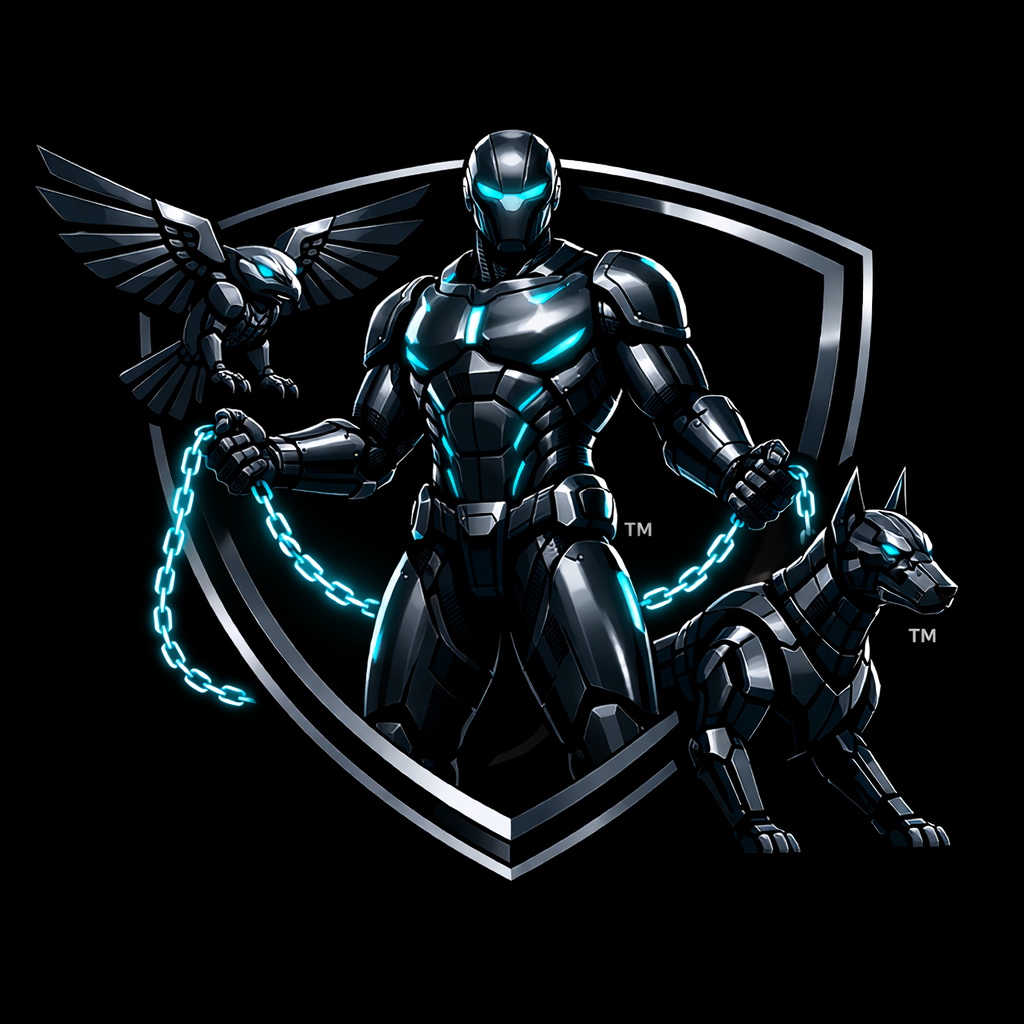
We built Guardian — a local enforcement layer that lives on the same machine as SAM, wrapping its arms around your business data and monitoring every action the AI takes. Guardian isn't a chatbot. It's a Deputy — the operational authority that ensures every AI action is safe, authorized, and cost-effective.
Guardian doesn't work alone. It operates with a specialized "Pack" of autonomous enforcement protocols:
Birddog
Perimeter Security & Connection Watcher
Birddog monitors every outbound connection from the SAM appliance. If an AI agent attempts to send sensitive business data to an unauthorized cloud endpoint, Birddog blocks the exfiltration in real time. Authorized endpoint whitelisting ensures data only flows where you've approved it — nowhere else.
Watchdog
Model Governance & Cost Control
Watchdog enforces efficiency. It monitors system idleness and model complexity. When the AI isn't actively working, Watchdog automatically reverts to low-cost model states, preventing expensive token burn. This is how we reduced operating costs by up to 90% — not by limiting capability, but by governing when expensive capability is used.
The architecture is deliberately modeled on law enforcement: the Sheriff lives in the cloud (global intelligence, model orchestration, updates). The Deputy and his Dogs live inside the building (local enforcement, data protection, cost governance). Your business gets the power of global AI with the security of a local workforce.
"We don't just provide AI; we provide Managed Governance. The AI works for you. Guardian makes sure it stays that way."
We decided that no one running our platform would ever get hit the same way again.
Not through policy. Not through better passwords. Through hardware-enforced architecture and autonomous enforcement protocols that make credential theft physically impossible and unauthorized actions operationally impossible.
USPTO #64/022,921 — Patent Pending
Chapter 06 — The Hardware Lock™
Security That Lives in Silicon, Not Software
A conventional software vault — HashiCorp Vault, AWS Secrets Manager, Azure Key Vault — moves credentials behind another layer of software. But if the machine is compromised, that software layer can be compromised too. The decryption key has to live somewhere, and wherever it lives becomes the new target.
The SAM Hardware Lock™ takes a fundamentally different approach: the decryption key lives inside a chip that physically cannot be read by software.
Every Apple Silicon Mac contains a Secure Enclave Processor — a dedicated cryptographic coprocessor isolated from the main CPU. The Hardware Lock generates a cryptographic key pair inside this chip. The private key never leaves the silicon. It cannot be extracted, copied, cloned, or transferred to another machine.
Before any credential is released, the system performs a three-step hardware verification:
①
Serial Number Match
The vault is bound to one specific machine's hardware serial number. A cloned drive or disk image running on any other hardware will fail.
②
Public Key Verification
The Secure Enclave's registered public key must match the key stored at vault creation. A regenerated or forged key will fail.
③
Live Challenge Signature
A cryptographic challenge is signed in real time by the Secure Enclave. This proves live physical possession of the registered hardware — no replay attacks.
Only after all three checks pass are credentials released — into RAM only, with a five-minute automatic expiration. Nothing is ever written to disk. When the token expires, the credentials are purged from memory.
| Security Dimension |
Industry Standard |
Hardware Lock™ |
| Credential storage |
Plaintext files on disk |
Hardware vault, RAM only |
| Breach yields credentials? |
Yes — all keys immediately readable |
No — zero credentials on disk |
| Cloned drive attack |
All credentials exposed |
Fails — wrong Secure Enclave |
| Remote exploitation |
Credentials accessible if machine breached |
Physical chip required |
| Credential time exposure |
Available indefinitely on disk |
5-minute ephemeral tokens |
| Setup complexity |
Varies — often requires DevOps team |
Single command initialization |
Chapter 07 — Why This Matters
The Gap Between Enterprise Security and Main Street Reality
Enterprise organizations deploying AI agents can layer them behind network segmentation, hardware security modules, dedicated SOC teams, and incident response playbooks. The blast radius of any single compromise is contained by infrastructure that costs millions to build and maintain.
Small and medium businesses have none of that.
A Main Street IT shop. A dental practice. A regional accounting firm. A franchise operator. These organizations are connecting AI assistants to their CRM, their accounting system, their email, their customer database — using the same plaintext credential architecture that every AI platform ships with by default.
They have no security team. They have no incident response playbook. When the breach happens — and in an ecosystem this young, breaches are inevitable — they lose everything connected to that agent.
The SAM Hardware Lock™ was built to close this gap. Not with enterprise pricing and enterprise complexity, but with a solution that ships as part of the platform. Every deployment — whether it runs in a franchise store in Chagrin Falls, Ohio or a managed services provider in Dallas — gets the same hardware-grade credential isolation that would cost an enterprise six figures to implement with traditional HSM infrastructure.
Chapter 08 — For Enterprise Licensors
What This Means for Your Evaluation
If you are evaluating AI orchestration platforms for deployment to your customers, your clients, or your franchise network, consider this:
Every AI agent platform you are evaluating stores credentials in plaintext on the host machine. This is not speculation — it is the current state of the industry. And it means that when you deploy one of those platforms to a customer site and it gets breached, your customer loses every credential connected to the agent. You, as the platform provider, bear the liability.
ToggleLogic eliminates that liability at two levels:
💰
Cost Control (ToggleLogic Engine)
Dynamic model routing reduces AI operating costs by up to 93%. Your deployments stay profitable at SMB price points. No customer gets a surprise API bill.
🔐
Security (Hardware Lock™)
Hardware-attested credential isolation ships standard with every deployment. No premium tier. No add-on. No DevOps team required. Patent-protected.
The Hardware Lock™ is not a replacement for your existing secrets infrastructure. It is a complementary layer that protects the last mile — the physical machine where the AI agent runs and where credentials must ultimately be decrypted for use. Your central vault protects secrets in transit and at rest. The Hardware Lock™ protects them at the point of use.
Seven patents protect the full ToggleLogic platform architecture. Licensors receive patent protection as part of the platform license. Competitors cannot replicate this architecture without licensing from Motherboard, Inc.
Built in Production. Proven Under Fire.
Ready to License.
We didn't build ToggleLogic because a product manager wrote a feature request. We built it because we got hit, and we decided it would never happen again.
Start a Conversation